Ice skate profiling templates. What they are, how they work & why you should care?
Skate profiling goes far beyond basic sharpening — it shapes the blade’s curvature along its length, tailoring how the skate interacts with the ice. With the right profile, your skates actively support your technique and translate your power and balance into better on-ice performance.
While sharpening determines how “bite-y” your edges are (via the hollow or radius of hollow), profiling determines how much blade touches the ice and where. This influences stability, balance, push-offs, agility and glide.
A skate blade profiled to a player’s specific needs supports skill development and goal-oriented training — not just sharp edges
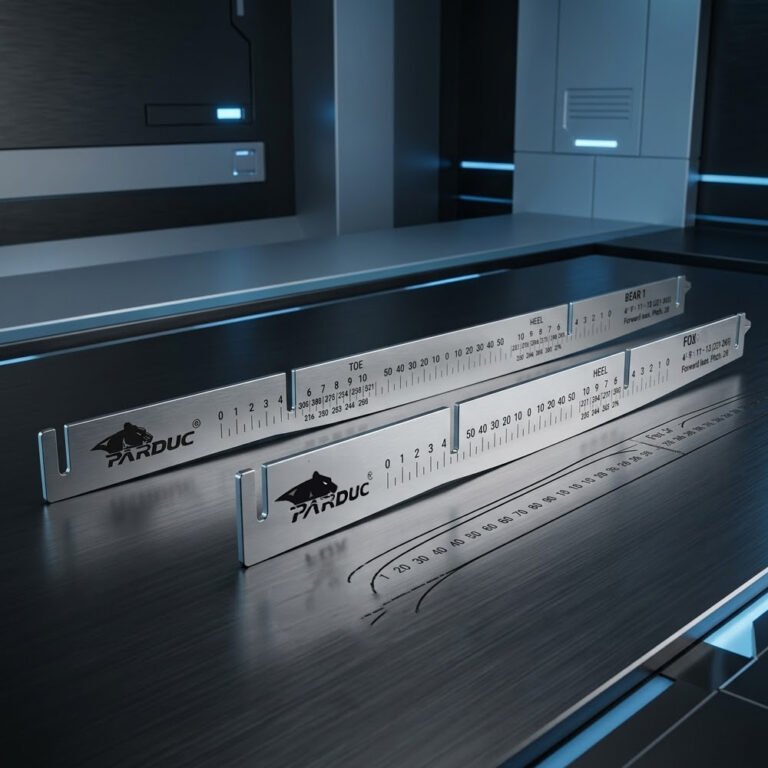
The core benefits of proper skate profiling
Better balance between agility & glide
Profiling allows you to balance competing characteristics of skate feel:
- Agility, grip and bite on one side
- Efficient glide, balance and speed on the other.
Finding the ideal compromise helps you skate more naturally and confidently.
Tailored performance for your style
Different player types benefit from different blade shapes:
- Forwards can benefit from forward-lean/forward-pitch profiles that emphasize acceleration and quick strides.
- Defensemen often prefer profiles that emphasize stability and balanced glide.
- Goalies often favour larger radii for balance and consistent push-offs.
Consistency across sharpenings
Once a profile is established, it should be maintained even as you sharpen. This ensures your skate feel stays consistent game after game.
Reduced fatigue & better efficiency
A profile that suits your style helps distribute weight more effectively across the blade, which can reduce muscle fatigue and improve endurance.
Technique Support & Skill Improvement
Rather than “fixing” technique, profiling ensures your blade supports your skating mechanics – so you’re not fighting the equipment.
Suited to skill level
- Beginners: profiles emphasizing stability and easy glide help with balance and confidence.
- Recreational/Intermediate: most standard multi-radius or dual-radius templates balance agility and glide.
- Competitive/Pro: precisely chosen templates — especially quad or continuous ones — allow fine-tuning of edge behaviour.
How profiling works in practice
Profiling adjusts the length of blade contact and the curve of that contact surface:
- Less surface contact → more agility and tighter turns
- More surface contact → improved glide and stability
It’s not a one-size-fits-all decision — even two skates from the same manufacturer may benefit from profiling for consistency.
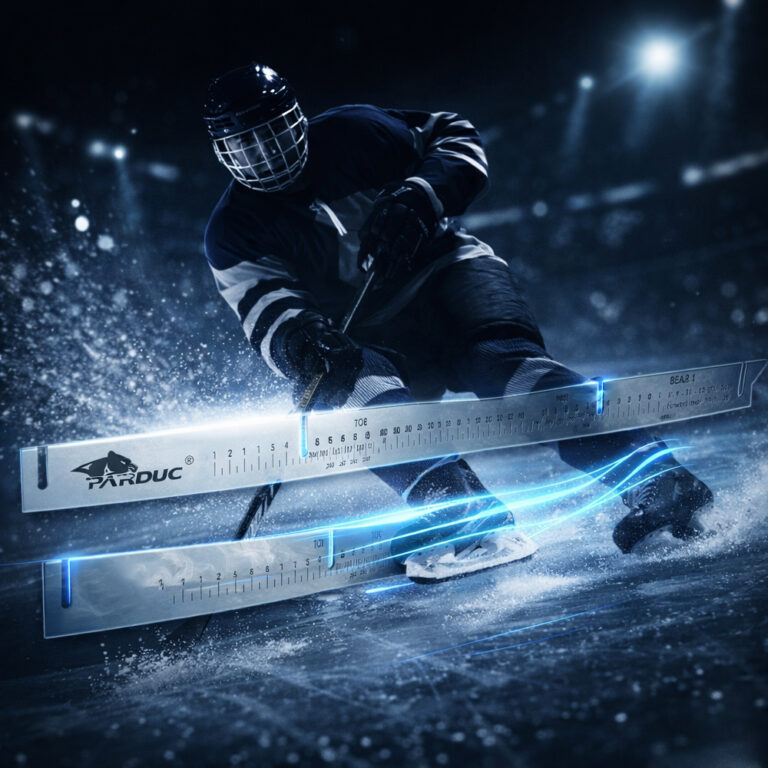
New Bear Jr & Fox Series Templates (Parduc)
Parduc’s profiling range covers a wide spectrum of templates from simple to advanced:
🐻 Bear Jr 1–3 Series
- Quad-radius profiles with a natural forward pitch — designed to give a slightly forward-leaning skate feel.
- This setup supports acceleration and explosive forward strides, ideal for competitive play and dynamic skating styles.
- The “Jr” designation indicates versions tailored for younger or smaller skaters, bringing high-performance profiling into youth hockey or development stages.
🦊 Fox Series
- A three-radius template with forward potential, bridging dual-radius simplicity and quad-radius complexity.
- Favours balanced acceleration and control, with smooth transitions between zones along the blade — a great option for players who want performance benefits without highly aggressive shaping.
Template | Radius Combination (ft) | Recommended Blade Size | Pitch | Key Characteristics |
BEAR JR1 | 4-5-7-10 | 212–221 mm | 13 mm forward pitch | Very quick acceleration and agility for the smallest junior players |
BEAR JR2 | 5-7-9-11 | 230–238 mm | 16 mm forward pitch | Balanced agility and glide for developing players |
BEAR JR3 | 6-8-11-12 | 246–254 mm | 18 mm forward pitch | More stability and speed for larger junior skaters |
Template | Radius Combination (ft) | Recommended Blade Size | Pitch | Characteristics |
FOX 5-9-13 | 5-9-13 | 212 mm and larger | 13 mm forward pitch | High acceleration, high agility, strong stability |
FOX 5-10-13 | 5-10-13 | 230 mm and larger | 16 mm forward pitch | Balanced agility and speed |
FOX 5-11-13 | 5-11-13 | 246 mm and larger | 17 mm forward pitch | Stability and speed with slightly reduced agility |
FOX 6-12-20 | 6-12-20 | 246 mm and larger | 18 mm forward pitch | High stability and glide |
FOX 6-13-20 | 6-13-20 | 272 mm and larger | 18 mm forward pitch | Balanced speed and stability |
FOX 6-14-20 | 6-14-20 | 280 mm and larger | 18 mm forward pitch | Designed for larger players |
FOX 6-17-20 | 6-17-20 | 280 mm and larger | 18 mm forward pitch | High speed and stability, also used by light goalies |
These templates, alongside the wider Parduc range (including RADIUS, COUGAR, EAGLE, BADGER), give technicians and players alike the tools to tailor skate behaviour to exact skating needs.
Why profiling matters
Skate profiling isn’t just an extra service, it’s a performance tool. When done with precision and intention, it boosts confidence, supports technique, and unlocks more potential from your equipment. High-quality templates like Bear Jr 1–3 and Fox from Parduc offer advanced shaping options for players at every stage.
Profile Type | Template name | Templates | Main Advantage |
Single Radius | Radius | 20 | Simple, predictable skating feel |
Dual Radius | Eagle | 9 | Acceleration + glide balance |
Triple Radius | Fox | 7 | Smooth transitions & speed |
Quad Radius | Bear | 7 | High-performance forward skating |
Flat + Radius | Cougar | 12 | Stability with controlled turns |
Elliptical | Badger | 6 | Progressive dynamic blade feel |